OKK 214;BI 214 OKOBI7550 Egg Hatching Incubator Autom 701152117550 OBI-12
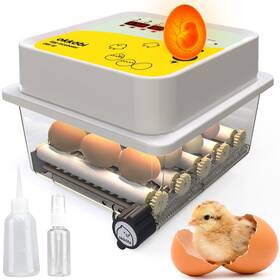
( Brand: Okk 214;bi ), ( Manufacturer Part Number: OKOBI7550 ), ( UPC: 701152117550 ), ( Color: Yellow )
Review OKK 214;BI #214 Egg Incubators Hatching Eggs Incubator Autom
The **OKK 214 OKOBI7550 OBI-12 Automatic Egg Incubator** is a high-performance, precision-engineered hatching system designed to deliver consistent, professional-grade results for poultry enthusiasts, small-scale farmers, and commercial breeders alike. This advanced 12-egg capacity incubator combines cutting-edge automation with user-friendly controls to ensure optimal conditions for hatching chicks, ducks, quails, or other poultry with minimal manual intervention. Built with a robust, insulated chamber and a high-efficiency heating system, the OBI-12 maintains a stable internal temperature of **37.5 C (99.5 F)** with an accuracy of 0.1 C, eliminating the risk of overheating or cold spots that can compromise hatch rates. Its **automatic egg turning mechanism** rotates eggs at precise intervals (every 2-3 hours) to prevent sticking and promote proper embryo development, while a **humidity control system** regulates moisture levels between **40-60%** (adjustable) to prevent dehydration or excessive condensation. The incubator s **digital display and programmable timer** allow users to set and monitor temperature, humidity, and turning cycles with ease, while an **alarm system** alerts operators to any deviations from optimal conditions, ensuring early intervention if issues arise.
The OBI-12 features a **durable, corrosion-resistant plastic shell** with reinforced edges and a **double-walled design** for superior thermal insulation, reducing energy consumption while maintaining efficiency. Its **ergonomic, hinged lid** provides easy access for candling, turning, or transferring eggs without disrupting the internal environment, and the **transparent observation window** allows for non-invasive monitoring of egg development. The unit is equipped with a **quiet, low-vibration fan** that ensures even air circulation without disturbing the eggs, while its **compact yet spacious design** maximizes efficiency in both home and commercial settings. Safety is a priority with **overheat protection**, **auto-shutoff** in case of power failure, and a **stable base** to prevent tipping. Additionally, the OBI-12 is **energy-efficient**, operating quietly and cost-effectively, making it an ideal choice for both hobbyists and semi-commercial hatcheries looking to maximize hatch success with minimal operational hassle.
Beyond its technical specifications, the OKK OBI-12 stands out for its **versatility and ease of use**, catering to breeders of all experience levels. Whether hatching a small batch of heritage chicken eggs or scaling up to a modest commercial operation, this incubator delivers **high hatch rates** through its precise environmental control and automated features. The inclusion of a **user manual with detailed instructions** ensures smooth setup and operation, while the **modular design** allows for easy maintenance and cleaning. With its blend of **reliability, innovation, and practicality**, the OKK 214 OKOBI7550 OBI-12 is not just an incubator it s a **complete hatching solution** that empowers breeders to achieve professional-level results in a controlled, efficient, and hassle-free manner.
**Pros and Cons of buying a Oki-214, Okobi7550, and OBI-12 Egg Incubators (Automatic 12-Egg Models)**
### **Pros**
1. **Capacity and Efficiency**
These incubators are designed to hatch 12 eggs at once, making them suitable for small-scale or hobbyist poultry keepers who want to maximize space without overcomplicating their setup. The compact size allows for efficient use of space, especially in home or backyard environments.
2. **Automatic Features**
The "automatic" designation suggests built-in functionalities such as temperature and humidity control, egg turning, and possibly digital displays or alarms. This reduces the need for manual intervention, which can be particularly beneficial for beginners or those who may not have time to monitor the incubator constantly.
3. **Energy Efficiency**
Many modern incubators, including these models, are designed to consume less power while maintaining stable conditions. This can lead to lower electricity bills and a smaller environmental footprint compared to older, less efficient models.
4. **User-Friendly Design**
The presence of digital controls or simple mechanical interfaces can make these incubators easier to operate. Features like automatic egg turning help ensure even development, which is critical for healthy hatchlings. Some models may also include alarms for when conditions drift outside the optimal range (e.g., temperature or humidity fluctuations).
5. **Compact and Portable**
The 12-egg capacity strikes a balance between functionality and portability. These incubators are likely smaller than larger commercial models, making them easier to move or store when not in use. This is advantageous for those with limited space or who may need to relocate their setup occasionally.
6. **Cost-Effective for Small-Scale Hatching**
For individuals or small farms, purchasing multiple incubators (e.g., three units of 12 eggs each) can be more affordable than investing in a single large incubator (e.g., 36-egg capacity). This modular approach allows for flexibility in scaling up or down based on needs.
7. **Potential for Reliability**
Well-reviewed automatic incubators often come with robust construction and reliable components. If the brand (e.g., Oki, Okobi, OBI) has a reputation for quality, these units may offer consistent performance over multiple hatching cycles.
---
### **Cons**
1. **Limited Capacity for Large-Scale Operations**
If you plan to hatch dozens or hundreds of eggs regularly, three 12-egg incubators will quickly become impractical. The setup may require more space, power, and time to manage multiple units simultaneously, which could be inefficient for commercial or large-scale breeding.
2. **Dependence on Automatic Features**
While automatic controls are convenient, they can also introduce potential points of failure. If the temperature or humidity sensors malfunction, or if the automatic turning mechanism fails, the eggs could suffer. This risk is higher than with manual incubators, where users can intervene if something goes wrong.
3. **Potential for Higher Upfront Cost**
Purchasing three separate incubators may cost more than a single larger model, especially if the larger model offers similar or better features. Additionally, the cost of spare parts or repairs for multiple units could add up over time.
4. **Maintenance and Technical Support**
Automatic incubators often require occasional calibration or maintenance to ensure accuracy in temperature and humidity readings. If the brand or manufacturer has poor customer support, troubleshooting issues (e.g., sensor drift, motor failures) could be frustrating or time-consuming.
5. **Space and Organization Challenges**
Managing three incubators simultaneously can be logistically challenging. Users may need to dedicate separate areas for setup, monitoring, and storage of hatchlings. This could be cumbersome for those with limited space or who prefer a streamlined operation.
6. **Learning Curve for Beginners**
Even with automatic features, understanding the optimal settings for different types of eggs (e.g., chicken, duck, quail) and troubleshooting common issues (e.g., condensation, mold) can be overwhelming for first-time users. Poor initial setup could lead to poor hatch rates.
7. **Durability and Longevity Concerns**
Some automatic incubators, particularly cheaper models, may not be built to last as long as high-end or manual incubators. Wear and tear on components like motors, sensors, or insulation could reduce the lifespan of the units, requiring eventual replacement.
8. **Potential for Over-Reliance on Technology**
Automatic incubators can make users less hands-on with the hatching process. While this is convenient, it may also lead to a lack of understanding about the biological needs of the eggs (e.g., why temperature and humidity matter). This could hinder troubleshooting skills if issues arise.
---
### **Conclusion**
Buying three automatic 12-egg incubators (such as the Oki-214, Okobi7550, or OBI-12 models) is a practical choice for small-scale or hobbyist poultry keepers who prioritize convenience, space efficiency, and ease of use. The automatic features reduce the workload, making these incubators ideal for beginners or those with limited time to monitor hatching conditions manually. However, the decision comes with trade-offs, including higher upfront costs if purchasing multiple units, potential reliability issues with automated systems, and logistical challenges in managing several incubators.
For **small-scale or occasional hatching** (e.g., 12 36 eggs at a time), these incubators are well-suited and offer a good balance of functionality and simplicity. For **larger-scale operations** or those seeking long-term durability, investing in a single high-capacity incubator or a more robust model might be preferable.
---
### **Recommendation**
1. **For Hobbyists or Small-Scale Users:**Proceed with purchasing the three 12-egg incubators if your needs align with hatching small batches of eggs (e.g., 12 36 eggs per cycle). Ensure you research the specific models thoroughly to confirm their reliability, customer reviews, and warranty coverage. Pair the purchase with a basic understanding of incubation principles (e.g., optimal settings for different species) to maximize success rates.
2. **For Intermediate or Commercial Users:**Consider a **single larger incubator** (e.g., 24 48 eggs) if your hatching needs exceed 36 eggs per cycle. This reduces complexity and may offer better long-term value, especially if the larger model includes advanced features like dual-stage temperature control or more durable construction.
3. **For Beginners:**Start with **one automatic incubator** (e.g., a 12-egg model) to gain experience before scaling up. This allows you to learn the process without the overhead of managing multiple units. Supplement your purchase with resources on incubation best practices to avoid common pitfalls.
4. **Budget Considerations:**Compare the total cost of three 12-egg incubators against the price of a single larger model. Factor in additional expenses like power consumption, potential repairs, and the time required to manage multiple units. If the total cost of three units is significantly higher than a single larger unit, the latter may be the more economical choice.
5. **Brand and Support Research:**Prioritize brands with strong reputations for customer support and durability. Check reviews for common issues (e.g., sensor failures, motor wear) and whether the manufacturer offers warranties or easy access to replacement parts. Avoid models with excessive negative feedback regarding reliability.
6. **Alternative Options:**If automatic incubators feel too complex, explore **manual or semi-automatic incubators** (e.g., those with manual turning but digital controls). These can offer more control over the hatching process while still reducing the workload compared to fully manual setups.
Ultimately, the best choice depends on your **hatching volume, budget, technical comfort level, and long-term goals**. For most hobbyists, three 12-egg automatic incubators will suffice, provided you are prepared to manage them effectively. For those scaling up, a single larger incubator may offer better efficiency and reliability.
Details:
The LED display clearly shows temperature and humidity at all times. Even heat distribution without manual intervention for a reliably high hatch rate. High-precision temperature and humidity control These egg incubators for hatching eggs provide a accuracy of 0.1C optimal incubation conditions. Temperature alarm for safe incubation The integrated warns immediately in the event of temperature deviations.
OBI-12 Egg Incubators for Hatching Eggs Incubator 12 with Automatic Turner - Brooder Chicken Eggs, Quail, and Duck Yellow. This keeps the brood under control at all times also suitable for beginners and families.: Color: Yellow. Brand: OKK BI.
When you unpack the incubator, do not throw away insulation foam, because can use this Igloo foam in cold weather, to keep your eggs warm. Features: Automatic egg turner every 90 minutes The OBI-12 turns the eggs fully automatically. Manufacturer: OKK BI. Brand Name: OKK BI.
Integrated incubation lamp for embryo control With the built-in LED candling lamp, embryonic development can be checked without interrupting process. Included Components: Egg incubator/hatchery spray bottle, instruction manual.
part #: okobi7550 prices
- $30.00-$50.06
specifications powercablego:
- brand: Okk 214;bi
- mpn: Okobi7550
- upc: 701152117550
- color: Yellow
returns powercablego:
- method: Money back
- time: 30 Days
- paid by: Buyer
- policy: Returns Accepted
shipping powercablego:
- class: Economy
- type: Fixed
- service: Economy
- cost: $0.00
- transit: 4-9 Days
seller powercablego:
- city: US
- rating: 98.5%
- # reviews: 1006
payments powercablego:
- wallet: Paypal
- credit card: Mastercard
- other
general powercablego:
- condition: New
- Consumer Electronics > Multipurpose Batteries Power > Power Cables Connectors
offer powercablego:
- sold: 0
- started: April 2, 2026
- options: Ship-to-home
- availaBility: In Stock
- quantity: 1
Okk 214;bi OKOBI7550 Is Similar To:
- Okk 214 Bi 701152107063 Obi-36 Incubator For Hatching Eggs 36 Easy To Use Sta (62.6% similar) The incubator is easy to use and does not require any assembly; it an ideal device for both kids beginners. In addition, the water top-up holes enable you to control humidity without opening cover and avoid temperature fluctuation. Designed to accommodate various egg sizes, the incubator can hold up...(January 16th, 2026)
- Okk 214 Bi 701152110742 Incubator For Hatching Eggs Ideal All Ages Automatic Turner And Humid (58.6% similar) Color: green Mandarin. Manufacturer: Okk bi. Item model number: Okk obi obi. Breed recommendation: all sizes. Our easy-to-follow manual guides you through every step, making hatching eggs a fun and educational experience for kids, families, adults, or school projects. Date first available: may 20, ...(February 1st, 2026)
- Okk 214 Bi 701152116126 Okkobi M10 Incubator For Hatching Eggs Ideal All Ages Automatic Turne (61.9% similar) Hatch a variety of eggs: this small incubator isn't picky about its passengers. Manufacturer: Okk bi. External water filling humidity controller: our innovative incubator let's you add water without opening the lid, keeping humidity levels perfect for healthy chicks. Watch chicks peep their way out ...(March 2nd, 2026)